
Climate zones in the grow tent: overall room climate vs. microclimate
Why humidity in the grow tent is not the same everywhere
Anyone who takes a closer look at the drying of cannabis will sooner or later come up against a seemingly simple question:
What is the actual humidity level in my grow tent? The answer is less trivial than many expect. This is because a grow tent does not have a uniform climate – but several climate zones that differ depending on position, air movement and plant condition. Understanding precisely this interaction is crucial for controlled, gentle drying.
A grow tent is not a homogeneous space
Even if temperature and humidity values are often regarded as fixed figures, in practice they are always spatially distributed. In terms of climate, a grow tent functions more like a small ecosystem than a room with a uniform temperature. Microclimates are inevitably created that differ in terms of humidity and temperature – even over short distances.
The plant zone (microclimate)
🌿 Higher humidity
Direct evaporation on the plant leads to higher humidity at certain points.❄️ Slightly lower temperature
Evaporative cooling cools the immediate surroundings of the plant minimally.🌫️ Moist boundary layer
A layer of moist air forms around flowers and leaves, which can only be removed slowly without movement.
The free air space (overall indoor climate)
Away from the direct plant surface, the evaporated moisture and the air layers from different tent areas mix. The result is an averaged indoor climate that is significantly more stable than the individual microclimates on the plant itself.
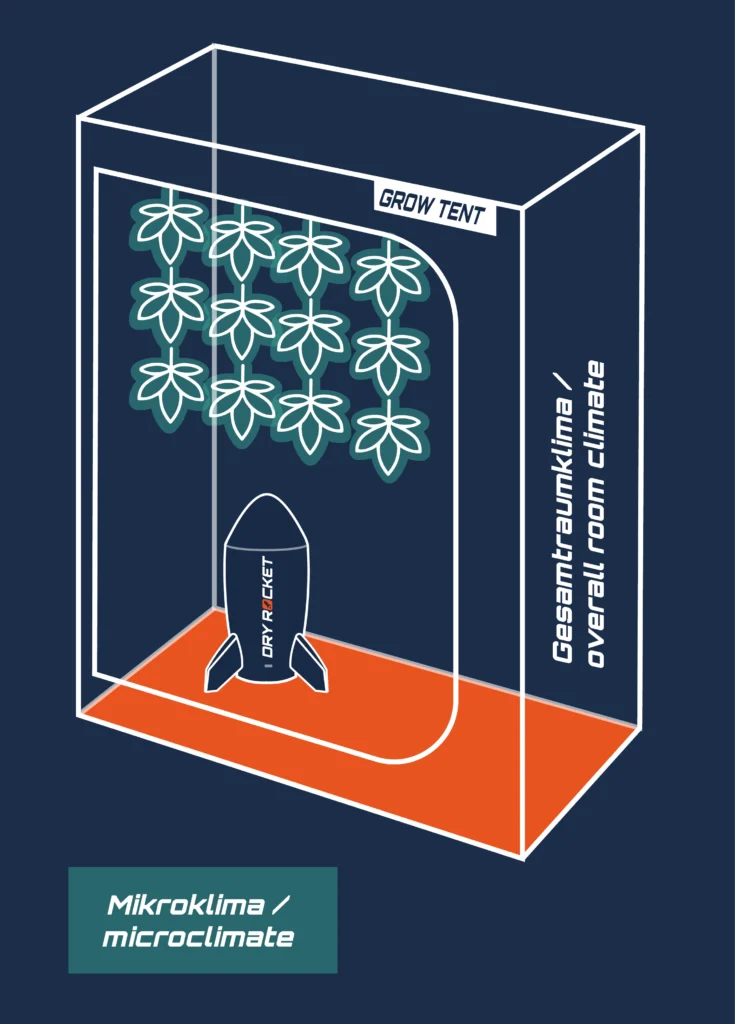
Why the overall indoor climate is crucial for drying
A hygrometer only ever measures its own location – not the climate of the entire room. Depending on the position in the tent, the proximity to the plants and the air circulation, the displayed values can therefore vary significantly. These values are not incorrect – however, they must be classified correctly.
Cannabis does not dry selectively, but via a continuous moisture transport. The decisive factor here is not the momentary measured value at a specific point, but the average climate in the entire tent. This overall room climate determines how much moisture the air can absorb and how evenly it is removed from the plant material. Local deviations directly at the plant are normal and unavoidable. If you were to focus exclusively on these, the climate would have to be set unnecessarily dry, which could lead to the surface drying out too quickly and a loss of quality.
Conclusion: Understanding the climate instead of interpreting individual values
Varying humidity levels in the grow tent are not a problem, but a natural effect of biological processes and physical laws. The decisive factor for controlled and gentle drying is not the individual measured value at a specific point, but a stable overall room climate that takes into account and balances out all climate zones through gentle air circulation.
DryRocket is designed precisely for this principle: Instead of regulating extreme values at certain points, the system records and stabilizes the overall room climate in the tent volume and thus supports uniform, quality-oriented drying.
Understanding measured values as part of an overall system and taking a holistic view of the climate creates the basis for reproducible results and maximum quality.

