
App FAQ: Questions about DryRocket
Questions before drying (setup)
Connection
Power supply: How do I know that DryRocket has power?
When DryRocket is plugged in for the first time, the internal fan briefly starts and then immediately switches off again. This short spin-up is the confirmation that the rocket is receiving power and starting up correctly.
Power interruption: What happens if the power connection is briefly interrupted during drying?
Short power interruptions have no negative impact on the drying process. As soon as power is restored, DryRocket automatically resumes the drying process exactly at the point where it was interrupted.
Internet connection failed: What should I do?
Please check the following to restore the connection:
Case A: Your DryRocket was already connected to your Wi-Fi
- Turn off Wi-Fi completely on your router (or briefly unplug the router).
- Leave Wi-Fi turned off and wait at least 60 seconds so that DryRocket automatically switches back to connection mode.
- Now open the app and try again to connect to DryRocket.
(Important: Wi-Fi must remain switched off at this point.) - As soon as the app asks which Wi-Fi network DryRocket should connect to:
- Turn Wi-Fi back on
- Tap “Refresh” (if necessary multiple times) until your Wi-Fi appears
- Enter the Wi-Fi password and establish the connection
Important: After turning Wi-Fi back on, you have about 20 seconds to establish the connection. (We are already working on an update to make this process more relaxed in the future.)
Case B: DryRocket has never been set up (initial connection)
- Completely close the app (do not just send it to the background).
- Restart the app and try again to connect to DryRocket.
- If it doesn’t work immediately, repeat the process.
If a connection is still not possible, try connecting directly to the DryRocket’s Wi-Fi via your phone’s Wi-Fi settings.
If this also does not work, please contact us again and we’ll clarify the next steps together.
Connection loss (internet): Will my drying process be interrupted?
Even if the Wi-Fi connection is temporarily lost, DryRocket continues to operate reliably and autonomously. The drying process is not interrupted and proceeds as intended. However, while the connection is disconnected, push notifications cannot be sent to your smartphone. As soon as the connection is restored, app communication will function as usual again. In this case, please check your router, your internet service provider, or whether the Wi-Fi signal at the DryRocket’s location is sufficiently strong.
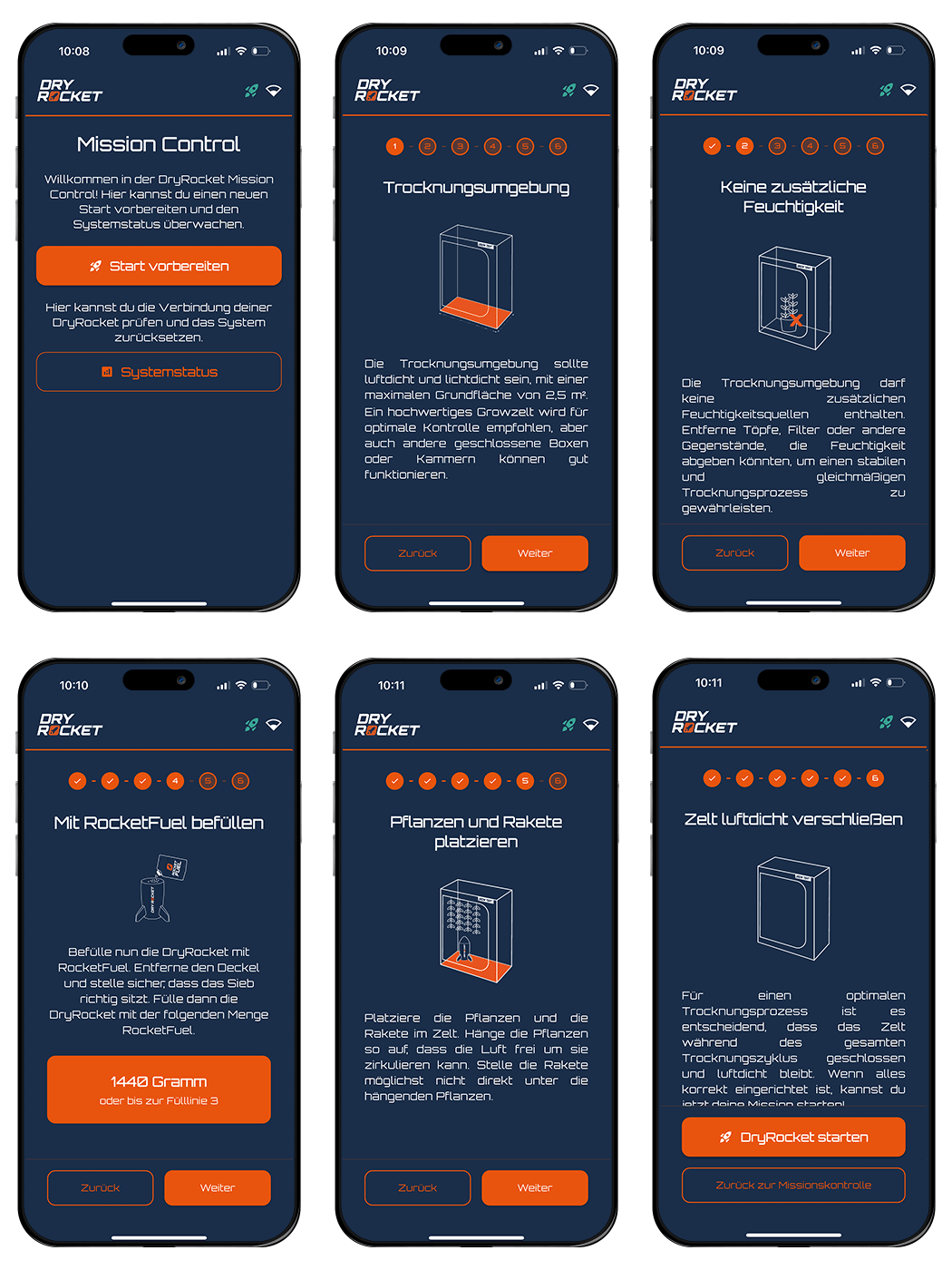
Drying Environment
Drying environment: What should it be like?
- Enclosed space (e.g. a grow tent)
- Floor area: <2.5 m²
- As airtight as possible—if necessary, you can seal leaks with tape, for example
- No additional fans, no carbon filter, no intake or exhaust air
Grow tent: Do I have to dry in a grow tent?
Of course, you can also use other enclosed locations (e.g. cabinets or boxes) for drying, as long as their size and airtightness are comparable. Make sure your drying environment is sealed as airtight as possible—if necessary, you can seal any leaks with tape.
Ventilation: Do I need additional air circulation?
No, additional ventilation is not necessary. DryRocket creates optimal drying conditions by gently circulating the air and regulating humidity. To allow the microclimate in the tent to stabilize properly, you should avoid using additional circulation fans. The rocket controls airflow through its own targeted impulses. External air movement could disrupt this finely tuned system and negatively affect the balance.
In short: DryRocket handles air circulation for you—additional fans are not required and can even be counterproductive.
Closed system: Why must the tent not be opened during drying?
To ensure your buds retain their full aroma, the tent must remain closed during drying. During the drying process, not only water evaporates, but also some of the volatile terpenes. In a closed system, these terpenes accumulate in the air until a natural equilibrium is reached. Once the air is saturated with terpenes, the buds release hardly any additional terpenes—the aroma stays where it belongs: in the bud.
If you open the tent, uncontrolled air exchange occurs: terpene-saturated air escapes and is replaced by terpene-poor ambient air. The result is renewed terpene loss and, at the same time, a disruption of the sensitive microclimate of humidity and VPD. Both can negatively affect quality.
Prepare Plants
Weighing: How do I determine the weight of my plants?
Ideally, use a digital kitchen scale or a spring scale to determine the fresh weight of your plants before drying. Weigh all parts to be dried before hanging them in the grow tent. The stems are also fully included in the weight, as they contain water as well.
Trimming: before or after drying? Wet trim or dry trim?
Whether you trim immediately after harvest (wet trim) or only after drying (dry trim) is mainly a matter of personal preference. Both methods are valid—the key factor is what works best for you.
Our preference:
After harvest, we only remove the large fan leaves and leave the actual trimming until after drying. This has several advantages: the plants dry more slowly and evenly, which better protects the terpenes, and trimming is often easier when the material is no longer sticky. This helps maintain high quality—with minimal stress for you and your plants.
DryBags: Can I combine them with drying?
DryRocket is designed to dry your buds directly. A DryBag would require a different drying profile (lower humidity levels). For this reason, we cannot recommend combining the two. At present, we also lack in-depth experience with this setup.
Placement: How should I position my plants in the grow tent?
This depends on your personal style and setup.
What’s important, however,
is to make sure your buds are not hanging too close together in order to avoid moisture pockets and to ensure sufficient air circulation around the plant material. Also make sure that the plants do not touch the DryRocket.
Our recommendation: We prefer to hang the plants whole or use a drying rack. This is particularly gentle, allows for even air circulation, and helps achieve optimal drying results.
Maximum drying amount: more than 1,000 g – is that possible?
Officially: No – DryRocket’s control system is currently designed for up to 1,000 g of fresh material.
Those who like to experiment and intelligently top up the granulate during drying may, with some luck and a good feel for the process, be able to handle larger quantities. However, the more material involved, the slower the moisture removal becomes—and the risk of mold increases significantly with overly dense and large batches.
We are still in the testing phase ourselves. Therefore, this is without guarantee and with a clear recommendation: please don’t risk your entire harvest.
Different harvest times: Do all plants need to go into drying at the same time?
For clean and even drying, all plants should ideally enter the drying process at the same time. This is due to the fundamental drying behavior of plant material: at the beginning, mainly surface water is released; later, moisture comes from deeper tissue layers. During this process, water activity changes significantly over time.
If plants harvested at different times are dried together, they behave differently from a physical standpoint—fresh material releases a lot of moisture, while more advanced material releases significantly less. These differences cannot be meaningfully combined in a single drying run with one uniform drying endpoint.
Fill with RocketFuel
Replaceability: Can I use other drying granulates?
No, DryRocket must only be operated with RocketFuel. RocketFuel is precisely calibrated for optimal VPD control by DryRocket in order to achieve the best possible drying results.
Quantity: How much RocketFuel do I need for my drying process?
The required amount of RocketFuel depends on the amount of fresh plant material and is shown to you in the app.
General rules:
A maximum of 2 bags of RocketFuel can be filled into the DryRocket per drying cycle.
When fully loaded, up to 1,000 g of fresh plant material can be dried per cycle.
Examples:
- 250 g fresh plant material = 0.5 packs of RocketFuel
- 500 g fresh plant material = 1 pack of RocketFuel
- 1,000 g fresh plant material = 2 packs of RocketFuel
Reusability: Can I regenerate RocketFuel?
In principle, silica gel can be regenerated by heating. However, household temperatures are often imprecise, which can reduce the granulate’s performance or damage it. If the absorption capacity becomes too low, premature saturation and an error message may occur. For this reason, we cannot recommend reusing it.
Questions during the drying process
Humidity
Why am I measuring different values?
During drying, different climate zones form inside the tent. Especially in the immediate surrounding of the plants, a microclimate develops (evaporative cooling and increased humidity). The humidity from this zone is reduced by the DryRocket’s gentle air circulation, gradually creating a homogeneous climate. The DryRocket takes these effects into account and evaluates the overall room climate. Through regular, short ventilation impulses, the air is circulated and the climate data is updated. Conventional, non-calibrated hygrometers may also show measurement deviations of around ±5%, which can further explain differences.
Humidity fluctuates: what should I do?
Fluctuations in humidity are normal in many setups and are usually directly related to temperature changes in the room (e.g. due to window ventilation or heating). Since relative humidity is always temperature-dependent, it can increase when the air cools down and decrease again when it warms up – even without any active intervention.
In addition, the plant material does not react instantly: transpiration has a certain latency, which means that changes in moisture can appear with a delay. Short-term fluctuations are therefore not a problem.
The DryRocket recognizes these relationships and automatically compensates for fluctuations as far as physically possible. What matters is not the instantaneous value, but that the humidity does not remain too high for an extended period of time. The drying process is designed precisely with this in mind.
Low humidity: what should I do?
If the humidity drops, this usually indicates that your tent is losing moisture to the surrounding environment. First, check whether the tent can be sealed more effectively (e.g. with tape or foil). If all openings are securely closed, low humidity can generally be treated as informational only.
DryRocket continuously calculates the drying endpoint based on a target water activity of 0.58–0.62 (58–62%). A slight drop in humidity toward the end is not unusual and will not affect the drying result (the VPD is somewhat higher, but during the stabilization phase this is not harmful to cells, as only very small amounts of water slowly diffuse outward from deeper cell layers). DryRocket will then end the drying process accordingly earlier.
Temperature
Which range is optimal?
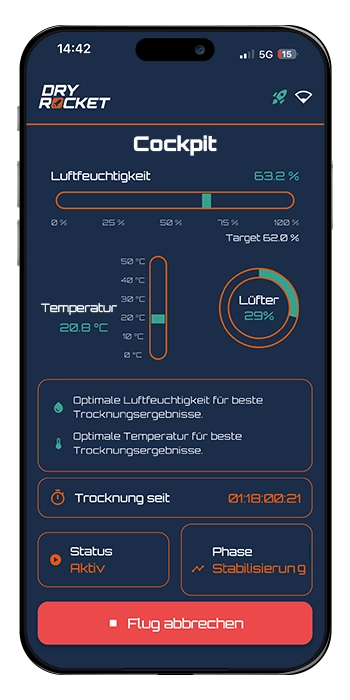
The optimal temperature range for drying with the DryRocket is 15–22 °C. Within this range, drying can be carried out particularly gently and in a controlled manner, which best supports the preservation of terpenes and aroma.
Above 23 °C: Is that too warm?
Temperatures between 15–22 °C are ideal, as they allow for the gentlest drying process and the best possible preservation of terpenes.
However, this does not mean that DryRocket does not work at higher temperatures—on the contrary. At elevated temperatures, some terpene loss is physically unavoidable. This makes it even more important to rely on a closed and precisely regulated system. Especially at temperatures above 23 °C, DryRocket helps slow down the drying process and keep it more controlled, which in turn benefits terpene preservation.
You can find more tips and background information on drying at summer temperatures in our blog.
Below 15 °C: Is that too cold?
Temperatures below 15 °C are generally not ideal, as the drying process slows down significantly. Under cooler conditions, plants release less moisture, which can unnecessarily prolong drying. However, DryRocket still operates reliably at lower temperatures and continues to control the drying process in a controlled manner.
Temperature fluctuates: what should I do?
No intervention is required. DryRocket automatically detects temperature fluctuations (e.g. due to day–night variations) and adjusts the humidity accordingly to keep the VPD value stable.
Drying Duration
How does DryRocket know when drying is complete?
DryRocket continuously monitors the evaporation activity within the closed system—that is, how much moisture the plants are still releasing into the environment. The drying process is considered complete when no measurable water release occurs over a defined period, or when the calculated drying endpoint is reached.
How does DryRocket determine the remaining drying time?
DryRocket determines the remaining drying time based on real-time data. The calculation is based on the currently measured moisture release from the plants as well as the current temperature within the system. From these values, it calculates how quickly water is still evaporating from the buds and how long the drying process is likely to take.
Because DryRocket operates on data rather than fixed time intervals, the displayed remaining time is dynamic. External influences such as temperature fluctuations can change the evaporation rate and thus adjust the remaining drying time accordingly.
Notifications
Message: Fan running for a very long time – what should I do?
This message appears when the fan has been active longer than intended. In most cases, this indicates that the drying granulate (RocketFuel) is already saturated and can no longer absorb moisture. Please check the granulate: if it is still orange, it is functional. If the beads are transparent, the granulate is saturated. In this case, replace it or refill the container up to the next fill mark. For easier handling, the device can be temporarily disconnected from the power supply. Drying will then automatically resume at the same point.
Message: Stabilization phase reached – am I on track?
Yes. This message means that the main drying phase has been completed and the stabilization phase has now begun. During this phase, DryRocket equalizes the residual moisture within the buds and controls the process in a controlled manner until the optimal drying endpoint is reached. Your setup is operating as intended—no intervention is required.
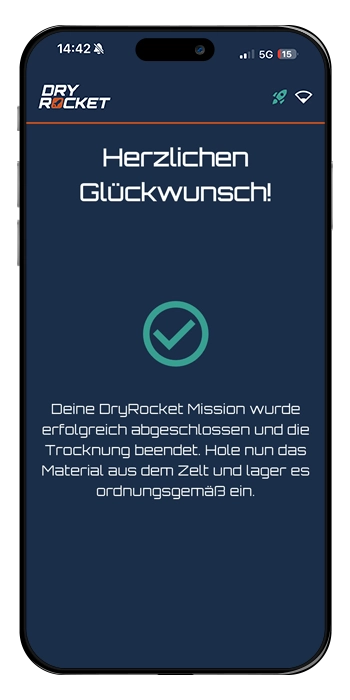
Message: Drying completed – whats next?
DryRocket has reached the target water activity and has therefore completed the drying process. Your buds are now ready for storage or curing. Especially after a short drying period, we recommend subsequent curing in jars for around 15–30 days, depending on the desired flavor profile, as chlorophyll breakdown occurs over time.
Message: Connection offline – what should I do?
Even if the Wi-Fi connection is interrupted, DryRocket continues to operate autonomously and carries out the drying process as intended. Only the app connection and push notifications are unavailable during this time. As soon as the connection is restored, communication will automatically resume as usual. In this case, please check your router, your internet service provider, or whether the Wi-Fi signal at the DryRocket’s location is sufficiently strong.
Phases
Drying phase: What happens during this phase?
During the drying phase, the majority of the water release takes place. At the beginning, there is a short phase with a slightly higher VPD to quickly remove excess surface moisture. This is important to rapidly reduce humidity and prevent mold during drying.
After that, drying continues gently at a lower VPD, allowing moisture to escape from the plant material in a controlled and even manner. The system automatically detects when water release decreases significantly and then independently transitions to the next phase—the stabilization phase.
Stabilization phase: What happens during this phase?
The stabilization phase is the final stage of drying and serves to homogenize the buds. From this point on, the remaining drying time is typically around 5–7 days, depending on VPD and temperature development. A slight drop in humidity during this phase is not unusual—especially if the tent is not completely airtight.
This decrease in humidity does not affect the drying result: although the VPD is slightly higher, it is not harmful to cells during the stabilization phase, as only very small amounts of water slowly diffuse outward from deeper cell layers. DryRocket continuously calculates the drying endpoint based on a target water activity of 0.58–0.62 (58–62%) and will end the drying process earlier accordingly if humidity decreases.
Questions after drying
Storage
Drying complete: Do I need to act immediately?
Ideally, you should respond promptly once drying has finished to cleanly conclude the process. However, if a few hours pass, this is not a problem. Once drying is complete, the plant material is in a stable state, and it is not an issue if the plants remain in the grow tent until the end of the workday.
Short drying duration: What should you pay attention to now?
With a short drying duration, chlorophyll has not yet been fully broken down. This can result in a slightly hay-like smell. Due to the closed system, you may perceive this smell—as well as the terpenes—more intensely. This is not due to “incorrect” drying, but rather because chlorophyll breakdown is primarily time-dependent.
For this reason, after short drying cycles we recommend additional curing in jars for around 15–30 days, depending on the desired flavor profile. During this phase, the remaining chlorophyll breakdown can be reliably completed.

